Premium Connections for Casing and Tubing: When and Why to Use Them
QUICK DEFINITION: PREMIUM CONNECTIONA premium connection is a proprietary threaded coupling engineered to exceed the sealing, torque, and fatigue performance of API standard threads (STC, LTC, BTC). The defining feature is a METAL-TO-METAL FACE SEAL— not thread compound — that provides gas-tight integrity at pressures exceeding 15,000 psi. Premium connections are certified under ISO 13679 CAL ratings (I–IV), with CAL IV representing full gas-tight qualification at 100% yield pressure.
1. Why API Standard Threads Fail in Critical Wells
API threads — Short Thread Coupling (STC), Long Thread Coupling (LTC), and Buttress Thread Coupling (BTC) — were designed in an era when wells were shallower, pressures were lower, and reservoir fluids were predominantly liquid. Their sealing mechanism relies entirely on thread compound ("dope") squeezed between mating flanks. This works adequately for water injection and low-pressure oil strings, but fails predictably in three scenarios:
1.1 Gas Migration Through Thread Compound
Dry gas molecules are small enough to permeate thread compound under differential pressure. API BTC connections carry no ISO 13679 gas-tight certification — there is no validated barrier against gas migration at wellbore pressure. In a gas well with 8,000 psi surface pressure and BTC connections, the thread compound is the sole sealing element. Field experience consistently shows compound extrusion and gas leakage at repeated makeup/breakout cycles, particularly following workover operations.
1.2 Torque Yield and Thread Jump-Out
API threads lack a positive torque shoulder. Makeup torque targets are calculated ranges based on thread geometry — not a physical stop. In high-angle or horizontal wells where running imposes torsional load on casing connections, API threads are vulnerable to over-torque (galling) and under-torque (jump-out). Jump-out — where the pin unseats from the box under combined tension and bending load — is the most common catastrophic connection failure mode in extended-reach completions.
1.3 Fatigue Cracking in Dynamic Environments
Subsea wells, deepwater risers, and wells subject to thermal cycling impose cyclic bending loads on casing strings. API connections have stress concentration points at the last engaged thread — where fatigue cracks initiate. Premium connections redistribute these stresses through engineered thread taper, nose geometry, and torque shoulder design, extending fatigue life by a factor of 3–10x compared to BTC.
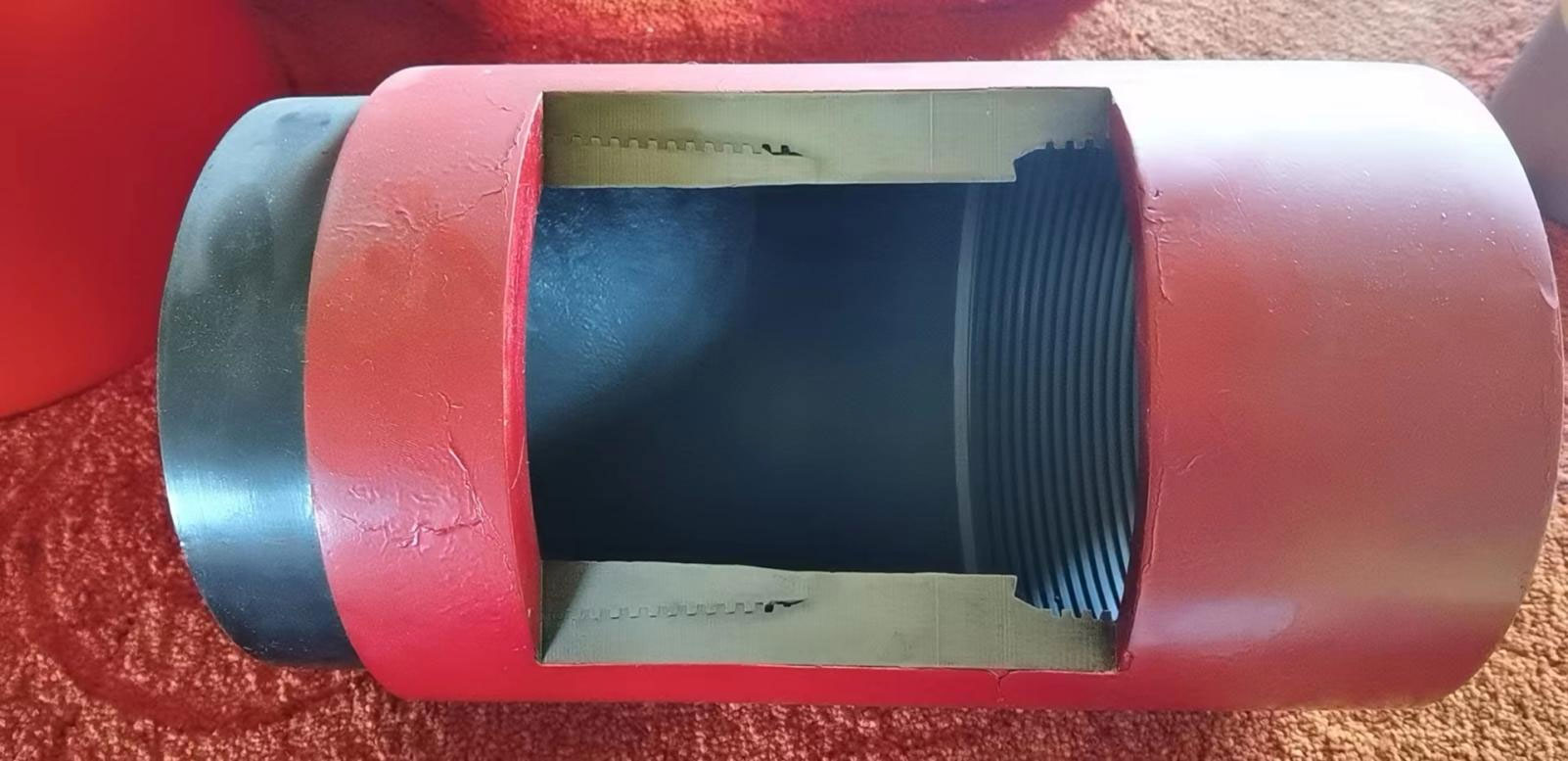
The table below summarizes the performance gap between API standard and premium connections:
| Property | STC | LTC / BTC | Premium (e.g. ZC-2) |
| Seal Type | Thread flank + dope | Thread flank + dope | Metal-to-metal face seal |
| Gas-tight Rating | No | No | Yes (CAL IV) |
| Max Pressure (typical) | ~5,000 psi | ~7,500 psi | 15,000–20,000 psi |
| Positive Torque Shoulder | None | None | Yes (physical stop) |
| Sealant Required | Yes (dope critical) | Yes (dope critical) | No (dry or minimal) |
| Fatigue Resistance | Low | Moderate | High |
| Makeup/Breakout Cycles | 3–5 | 3–5 | 10–20 |
| Cost Index (vs STC) | 1.0x | 1.1–1.2x | 2.5–5.0x |
2. The Metal-to-Metal Seal: How Premium Connections Actually Work
The gas-tight performance of premium connections depends on a metal-to-metal (MTM) face seal — a precision-machined contact between the pin nose and the box counterbore. When correctly made up, the pin nose is compressed radially against the box, creating a seal that is:
Independent of thread compound — compound serves as a corrosion inhibitor and galling preventative, not the primary pressure barrier
Self-energizing under internal pressure — higher wellbore pressure increases contact stress at the seal face, improving integrity as pressure increases
Repeatable across makeup/breakout cycles — engineered interference tolerances maintain seal integrity through workover operations, unlike compound-dependent API threads
The positive torque shoulder serves a second critical function: it defines a physical makeup stop, eliminating the torque-range ambiguity of API connections. Once the shoulder contacts, torque climbs sharply — clearly detectable on the rig's torque-turn monitoring system. This eliminates both under-makeup (leak path) and over-makeup (galling or seal damage) failure modes in a single mechanism.
Tribal Knowledge — Torque-Turn MonitoringIf a premium connection is made up without a visible torque shoulder bump on the torque-turn graph, the pin nose has not fully seated against the box. Do not accept the connection. Strip it out and inspect for galling, dimensional non-conformance, or dope contamination on the seal surface. A "silent" torque curve on a premium connection is a failed connection.
3. ISO 13679 CAL Ratings: What They Mean for Selection
All premium connections are qualified under ISO 13679, which defines Connection Acceptance Levels (CAL I–IV). The CAL rating determines what pressure, temperature, and fluid conditions the connection has been tested to survive. Specifying a premium connection without verifying its CAL rating provides no assurance of performance.
| CAL Rating | Test Medium | Pressure (% of Yield) | Gas-tight? | Typical Application |
| CAL I | Water | 80% | No | Water injection, non-critical strings |
| CAL II | Water | 100% | No | Standard oil production, liquid-only wells |
| CAL III | Gas | 80% | Partial | Gas wells, moderate pressure |
| CAL IV | Gas | 100% | Yes — full | HPHT, gas, deepwater, sour service |
Critical Engineering PointCAL IV is the mandatory minimum for any gas well, HPHT application, or subsea completion. Specifying CAL II on a gas injection string to reduce cost is a false economy — a single connection leak in a gas injector can result in well shut-in, regulatory reporting, and workover costs that exceed the premium connection cost differential for the entire string.
For ISO 13679 CAL rating explained and connection selection by well type, see our Premium Connection CAL Ratings Guide.
4. Connection Types: Coupling, Flush, and Semi-Flush
Premium connections are divided into three geometric families, each designed for different wellbore constraints:
4.1 Coupling-Type (External Upset)
The most common configuration. A coupling sleeve bridges pin and box, with an OD larger than the pipe body. This provides maximum structural efficiency — full load shoulder area and maximum seal surface. The trade-off is increased OD, which can restrict annular flow or create centralizer interference in tight wellbores. ZC-1 and ZC-2 are coupling-type.
4.2 Flush-Type (Integral Joint)
Threads are machined directly into the pipe body with no external coupling, achieving an OD equal to or less than the pipe body OD. This eliminates annular flow restriction entirely and allows passage through tight doglegs without coupling hang-up. The structural trade-off is reduced wall thickness at the thread zone, which typically reduces tensile efficiency to 60–80% of pipe body yield. ZC-3 (VAM FJL equivalent) is flush-type.
4.3 Semi-Flush Type
A compromise geometry that reduces OD by 50–70% compared to full coupling while maintaining higher tensile efficiency than true flush designs — typically 85–95% of pipe body. Most widely used in extended-reach wells where flush is over-specified but coupling-type creates flow restriction. ZC-4 (PH-6 equivalent) and ZC-5 (Hydril CS equivalent) are semi-flush.
5. ZC Premium Connection Specifications
The following table covers ZC Steel's premium connection product line with industry-equivalent designations, for direct specification in well programs and purchase orders:
| ZC Grade | Industry Equivalent | Type | CAL Rating | Key Feature | Primary Application |
| ZC-1 | NEW VAM | Coupling | CAL II | Gas-tight, single shoulder | Standard HPHT oil wells |
| ZC-2 | VAM TOP | Coupling | CAL IV | Metal-to-metal seal, full gas-tight | Deep offshore, HPHT, deviated wells |
| ZC-3 | VAM FJL | Flush | CAL IV | Flush OD, zero annular restriction | Extended-reach, multilateral wells |
| ZC-4 | PH-6 | Semi-flush | CAL IV | Reduced OD, high tensile efficiency | Tight annulus wellbores |
| ZC-5 | Hydril CS | Semi-flush | CAL IV | Double shoulder, maximum torsional resistance | HPHT, high-torque completion strings |
| ZC-CC | Proprietary | Coupling | CAL IV | Enhanced fatigue, corrosion-resistant coating | Sour service, corrosive well environments |
| ZC-CV | Proprietary | Coupling | CAL IV | High collapse rating, gas-tight | High-pressure shallow completions |
Specification NoteZC-2 (VAM TOP equivalent) and ZC-5 (Hydril CS equivalent) are the standard specifications for HPHT, deepwater, and high-angle well programs. Both carry CAL IV certification — the only rating that validates gas-tight integrity at 100% yield pressure using gas as the test medium.
6. When to Use Premium vs. API Standard: Decision Matrix
The most common misspecification error is applying premium connections where API performs adequately (over-engineering, unnecessary cost) or using API threads where gas-tight integrity is required (under-engineering, operational risk). The following matrix defines the appropriate specification for each well condition:
| Well Condition | API Standard Acceptable? | Recommended ZC Grade |
| Shallow oil well (<5,000 ft, sweet, liquid only) | Yes — STC or LTC adequate | N/A (API sufficient) |
| Onshore gas well, moderate pressure | Marginal — BTC at its sealing limit | ZC-1 (CAL II minimum) |
| HPHT well (>10,000 psi, >300°F) | No — gas-tight seal required | ZC-2 or ZC-5 (CAL IV) |
| Deepwater / subsea completion | No — fatigue and pressure criteria exceed API | ZC-2 (CAL IV) |
| Extended-reach / deviated well (>60°) | No — bending fatigue and jump-out risk | ZC-3 flush or ZC-4 semi-flush |
| Sour service well (H₂S present) | No — corrosion and SSC risk at connections | ZC-CC (corrosion-resistant) |
| Tight annulus / multilateral wellbore | No — coupling OD creates clearance problem | ZC-3 or ZC-4 |
| High-torque completion or liner string | No — thread jump-out risk under rotation | ZC-5 (double shoulder) |
| Water injection string, non-critical | Yes — BTC with proper dope application | N/A (API sufficient) |
7. Cost Justification: Premium vs. API Total Cost of Ownership
Premium connections carry a 2.5–5x unit cost premium over API BTC. In a standard 10,000 ft intermediate casing string with Range 2 pipe (approximately 333 joints), specifying ZC-2 over BTC adds roughly $150,000–$300,000 in material cost depending on OD and grade. This cost must be evaluated against the risk-weighted cost of an API connection failure in the same environment:
Single gas leak on a subsea casing string: $2–10M workover + regulatory reporting + potential well shut-in
Thread jump-out on an extended-reach completion string: Full string loss, sidetrack required, $5–20M NPT
Galled API thread requiring re-run: Rig time, thread repair or joint replacement, schedule impact
Failed BTC on gas injection well: Injection shutdown, production deferment, environmental incident reporting
The standard engineering approach is risk-weighted: apply premium connections on strings where an API connection failure would result in well loss, environmental incident, or unrecoverable NPT. Surface casing in a shallow land oil well does not meet this threshold. Production tubing in a 15,000 psi HPHT gas well always does.
Procurement Note — Lead TimePremium connections are not typically stocked as commodity inventory. ZC-2 and ZC-5 (CAL IV grades) carry 6–12 week lead times for non-standard OD and weight combinations. Include connection delivery in your critical path schedule. API BTC connections, by contrast, are typically available from distributor stock.
8. Frequently Asked Questions
Can I substitute BTC for a premium connection if the well is sweet and non-HPHT?
Yes — for liquid-only production strings in sweet wells below 5,000 psi and 200°F, BTC with proper dope application and torque control provides acceptable sealing performance. The substitution becomes unacceptable when: (a) gas is present at any significant partial pressure, (b) the string will experience cyclic bending in a deviated or deepwater well, or (c) the well program requires multiple workover cycles that will repeatedly stress the connection.
Why is ZC-2 specified over ZC-1 for HPHT wells when both are coupling-type?
ZC-2 (VAM TOP equivalent) is qualified to CAL IV — full gas-tight certification at 100% yield pressure using gas as the test medium. ZC-1 (NEW VAM equivalent) carries CAL II certification — water-tested at 100% yield, but not gas-tested under combined load conditions. In HPHT gas environments, the distinction is operationally critical: a CAL II connection has no validated gas sealing capability at wellbore pressure and temperature.
What is the double-shoulder design in ZC-5, and when does it matter?
ZC-5 (Hydril CS equivalent) uses a dual-torque-shoulder geometry — an internal shoulder at the pin nose and an external shoulder at the coupling face. This design provides two torque references during makeup, dramatically increasing torsional resistance compared to single-shoulder designs. The double shoulder is critical in high-torque applications: rotating liner strings, casing-while-drilling, and completion strings in high-angle wells where running torque approaches makeup torque limits on single-shoulder connections.
How many makeup/breakout cycles can a premium connection handle?
API standard threads are typically rated for 3–5 makeup/breakout cycles before thread damage risk becomes unacceptable. Premium connections are typically rated for 10–20 cycles depending on type. ZC-3 flush connections, which machine threads directly into the pipe body, carry the most restrictive cycle limits — typically 5–8 — due to reduced steel volume available for re-cutting. Always obtain cycle ratings from the connection qualification documentation, not the product brochure.
Is thread compound (dope) still required with premium connections?
For most premium connections, a light application of API-modified thread compound is recommended on the pin threads as a corrosion inhibitor and galling preventative during makeup — it is not the primary seal. Critically, compound must never be applied to the pin nose seal surface on a metal-to-metal design. Compound on the seal face prevents full metal contact, compromising gas-tight integrity. Always follow the connection manufacturer's specific dope application procedure, which will specify where compound is permitted and where it is prohibited.
What causes premium connection seal failure in the field?
The three most common failure modes are: (1) Insufficient makeup — the pin nose has not fully seated against the box due to under-torque, incorrect dope viscosity, or handling damage to the seal surface before running; (2) Galling — surface damage during makeup caused by incorrect running speed, contaminated threads, or incompatible coatings; (3) Thermal cycling damage — repeated temperature excursions in HPHT wells cause differential expansion between pin and box, gradually relaxing contact stress at the seal face over the well life. All three are preventable with correct running procedures and pre-run inspection.
The commonly used premium connections include the following types: coupling-type, flush-type, semi-flush-type, extra-flush-type, and quick-connect-type. Some of the most representative premium connections are ZC-1 (NEW VAM), ZC-2 (VAM TOP), ZC-3 (VAM FJL), ZC-4 (PH-6), ZC-5 (HYD CS), ZC-CC, and ZC-CV. These premium connections offer excellent thread sealing performance, resistance to torsion, and improved efficiency. They are suitable for various oil well development needs. By enhancing the connection performance of the oil casing, they improve wellhead sealing, reduce the risk of leakage and environmental accidents, and provide significant benefits to oilfield operations.


